

Highlighting the excellence of individual contributions:
Showcasing exceptional talents in the architecture and design sector by enhancing their outputs.
The award, in its second cycle, aims to celebrate built environment projects that have embraced the charter's standards and demonstrated excellence in their execution. It seeks to motivate practitioners and specialists to adopt the concept and standards of the charter within their urban outputs, working towards creating a competitive environment that produces high-quality results.

Showcasing exceptional talents in the architecture and design sector by enhancing their outputs.

Improving design quality and encouraging designers to create more distinctive and high-quality outputs.

Enhancing societal and practitioner awareness in the architecture and design sector of the values and concept of the charter and its impact on society.

Understanding the effects and efforts of experts in the architecture and design sector.

Encouraging practitioners in the sector to adopt the values of the King Salman Charter for Architecture and Urbanism.
This category refers to distinguished built environment projects that have been designed, executed, and operational.
This category focuses on outstanding built environment designs for projects that have not been constructed completely, emphasizing unique urban outputs in design, creating new and innovative architectural design visions.
The award targets the following main categories:

Architectural and design
companies and offices

Owners of distinguished
architectural projects

Individual architects and
designers or groups
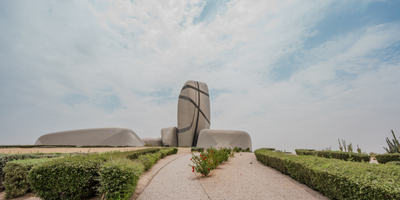
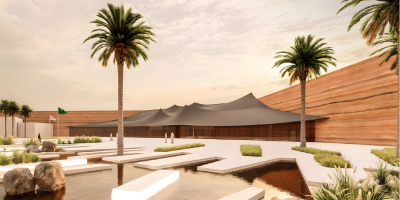
Description: A global cultural building in Dhahran, combining authenticity and innovation. It is distinguished by its unique design inspired by rocks and the earth, clearly embodying the value of "Authenticity" through the use of Mashrabiya and rammed earth in its interior spaces. The jury praised the project's program for the diversity of spaces, the quality of construction, and its innovative approach to sustainability by placing a significant part of the mass underground.
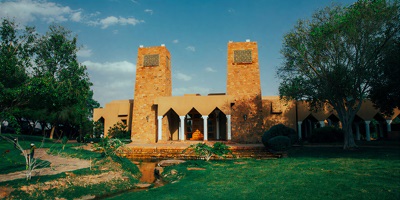
Description: A non-profit cultural center in Al-Ghat Governorate, reflecting the local traditional character using indigenous building materials like straw bales and clay. The project embodies "Authenticity" and "Continuity" by clearly integrating traditional elements with a modern approach that meets functional and climatic demands. The jury considered it an exceptional project for utilizing low-tech environmental strategies, such as the underground cooling system and wind catchers, thus avoiding mechanical systems.
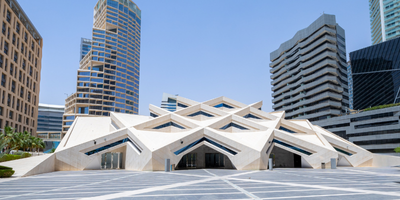
Description: A prominent Islamic landmark in King Abdullah Financial District (KAFD), featuring a design inspired by the crystalline planes of the Desert Rose. It represents an innovation in mosque design, challenging the height of surrounding towers and abstracting the Najdi triangle element. The jury praised the strong visual presence and design language of the mosque amidst the high-rise buildings, and the designer's masterful solution for the complex roof structure, which created a powerful visual composition.
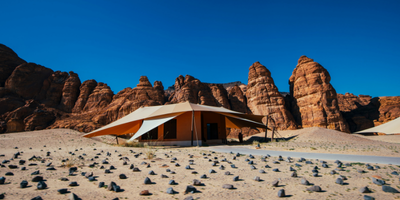
Description: A resort in AlUla's Ashar Valley, celebrating the desert environment and the site's rich heritage. The design was inspired by the Bedouin way of life, featuring tent-like suites that seamlessly merge with the landscape. The jury praised the architect's sensitive handling of this area of exceptional natural beauty, which minimized the project's impact. The design of the lightweight tent structures was considered a successful reinterpretation of traditional concepts and forms.
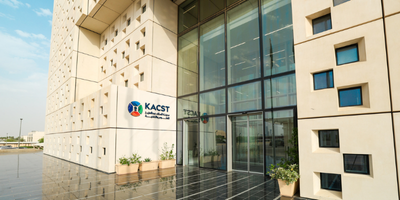
Description: A high-rise building in Riyadh embodying "Innovation" and "Liveability". Its GRC panel façade smartly responds to climatic conditions to provide optimal shade and sun permeability. The jury praised the internal spatial organization and quality, which produced a highly interactive and social working environment. The placement of vertical circulation (elevators) on the building's sides was also highlighted as a particularly clever move to manage thermal performance and free up internal space for social interaction.
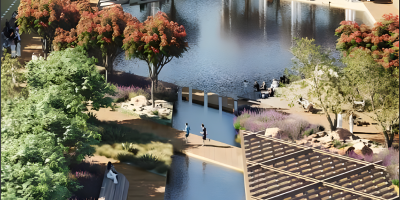
Description: A master plan project aiming to create a sports and wellness ecosystem connecting Wadi Hanifa and Wadi Al-Sulai. It seeks to achieve a comprehensive urban transformation while preserving the city's heritage and culture, by creating nearly 5 million square meters of green space. The jury viewed it as a commendable effort to create a new environmental corridor for the city, and praised the design approach to landscape architecture, particularly the focus on native trees and planting strategies.
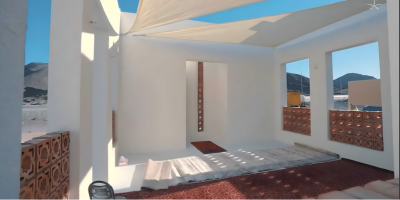
Description: An integrated design for roadside prayer spaces in multiple locations, aiming to merge traditional Islamic heritage with modernity. The project embodies "Authenticity" through the utilization of the environment and its available resources, and "Innovation" in the design of the ventilation model and the indirect entry of sunlight. The jury felt that "Mihrab" beautifully and simply offers an approach to infrastructure for integrating places of worship into daily life, being a standardized, repeatable, and customizable system.
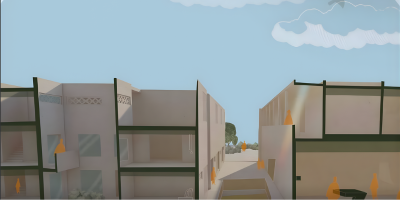
Description: An architectural thesis by student Sadeem Al-Jbreen from Sheffield University. It focuses on reviving the identity and values of Saudi culture in a contemporary design, using a low-rise, high-density approach that simulates old neighborhoods. It embodies "Authenticity" and "Continuity" by successfully blending the old and the new with a suitable living environment. The design focused on meeting social and religious needs, dividing the house into two sections (for guests and family) while ensuring privacy and hospitality.
Description: A graduation project by student Abdulaziz Ghanem Al-Talib from King Saud University. It aims to enhance the presence of the Arabic language with an authentic Najdi identity. It demonstrated a high level of skills and design excellence. It was distinguished by "Innovation" in terms of optimal design for flexibility of use, and environmental solutions like wind catchers that create thermal comfort. The focus on "Human-Centricity" and community integration through diverse interactive activities and spaces was highly praised.
The award is part of the strategy to activate and adopt the King Salman Charter for Architecture and Urbanism, targeting two main tracks (Built Projects , Non-Built Projects) You can find details about the award on the award profile page on the official website.
To participate in the award or apply to one of its tracks, click "Register Now" below, then choose the track that suits you (Built Projects, Unbuilt Projects) and follow the instructions provided there.
"Register Now"Once you have completed the submission, you will receive a confirmation email confirming the successful registration.
Creating architectural excellence and improving the quality of life of all residents through forming architectural environments that builds on cultural and environmental heritage and emulates the future.
For over five decades, Custodian of the Two Holy Mosques, King Salman bin Abdulaziz - may God preserve him - served as the governor of the Riyadh region, during which he established a vision in architectural design. He led the development of remarkable architectural works that reflect his distinctive character in design quality. Over many decades, various projects have attempted to showcase their affiliation and strengthen their connection to the concepts of urban quality, even if they did not meet the standards set by the Custodian of the Two Holy Mosques. Therefore, the Charter aims to create a common understanding of the concepts of urban quality in the Kingdom, providing guidelines for those involved in design, planning, and construction. It is an urban message with aesthetic value documented to the world's peoples, cultures, and civilizations. You can learn more about the Charter through the following link.
On 5 February, 2026.
Projects will be assessed based on criteria inspired by the values of the Charter:
Authenticity: The presence of a tangible design logic or intellectual process seeking to create urban and architectural spaces that express authenticity and distinguish themselves from the place.
Continuity: Sustainable growth and continuous development of a local community that celebrates national identity, respects the past, and is rooted in an understanding of the physical fabric and local culture of the community.
Human Centricity: Focus on individuals and groups in the axis of any design to improve experiences, inclusivity, and social justice.
Livability: Attention to raising the quality of life by establishing a safe, attractive, healthy, and socially interconnected urban environment to suit all citizens.
Innovation: Providing mental space for exploring new horizons often through collaboration with partners who have a different perspective or possess complementary knowledge.
Sustainability: Consciously protecting and enhancing the environmental, social, and economic aspects.
Soon to be announced.


